

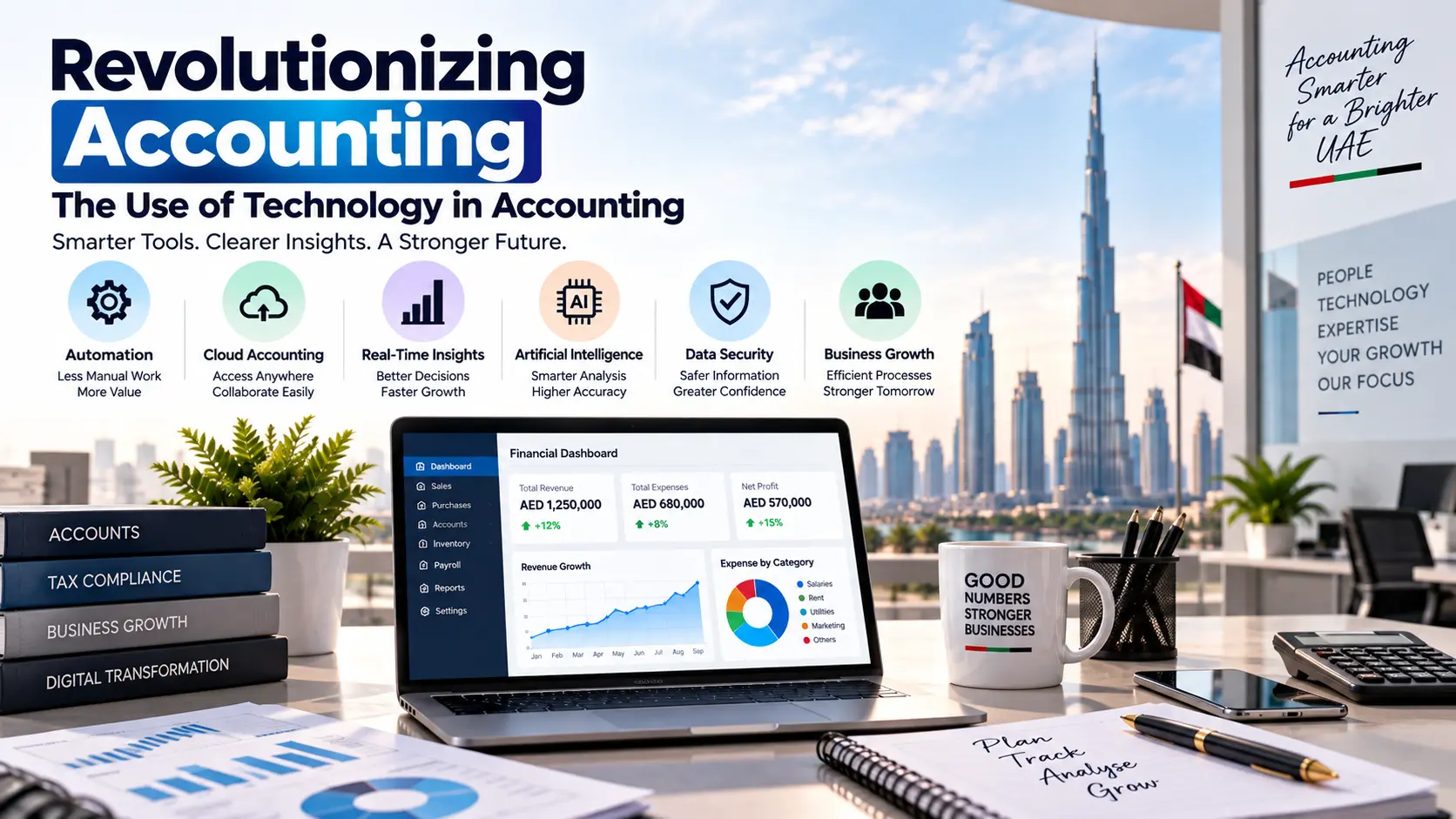
Technology has changed the way businesses manage their finances. Accounting is no longer limited to entering transactions into spreadsheets, checking invoices manually, and preparing reports at the end of the month.
Today, technology in accounting helps businesses automate routine work, organise financial information, improve reporting and give management a clearer view of business performance.
For UAE businesses, this shift is especially relevant as companies increasingly rely on digital accounting systems to manage bookkeeping, VAT records, Corporate Tax information, invoicing, payroll and financial reporting.
However, technology does not replace the need for professional accountants. Instead, it gives accounting professionals better tools to spend less time on repetitive tasks and more time analysing financial information, identifying issues and supporting business decisions.
Let’s look at how technology is transforming modern accounting and what businesses can realistically expect from it.
Key Takeaways
- Accounting technology can automate repetitive financial tasks and reduce manual data entry.
- Cloud accounting allows authorised users to access financial information remotely.
- Data analytics can help businesses understand revenue, expenses, cash flow and profitability.
- Artificial intelligence is increasingly being used to support accounting processes, but human review remains important.
- Integrated accounting and ERP software can connect finance with sales, purchasing, inventory and other business functions.
- Strong security, user permissions and regular backups are important when financial information is managed digitally.
- Technology works best when businesses combine the right software with accurate data and professional accounting processes.
What Is Technology in Accounting?
Technology in accounting refers to the use of software, cloud platforms, automation, artificial intelligence, data analytics and other digital tools to manage financial information and accounting processes.
Traditional accounting often required employees to perform many tasks manually. For example, an accountant might have to collect invoices, enter transaction details, reconcile bank statements and prepare reports separately.
Modern accounting software can bring many of these activities into one system.
Depending on the software, businesses may be able to manage:
- Bookkeeping
- Invoicing
- Accounts payable
- Accounts receivable
- Bank reconciliation
- Expense management
- Payroll
- Inventory
- Financial reporting
- VAT-related records
- Management reporting
The exact features vary between accounting platforms, so businesses should select software according to their actual requirements rather than simply choosing the system with the most features.
How Technology Is Revolutionizing Accounting
1. Automation Reduces Repetitive Accounting Work
One of the most noticeable benefits of accounting technology is automation.
Accountants and finance teams often spend considerable time on repetitive activities such as data entry, invoice processing, transaction categorisation and bank reconciliation.
Accounting software can automate parts of these processes, depending on how the system is configured.
For example, bank feeds can help bring transaction information into accounting software, while recurring invoices can reduce the need to create the same invoice manually every month.
This saves time and allows accounting professionals to focus on activities that require human judgement.
Automation does not mean that every transaction should be accepted without review. Businesses still need proper controls to check whether transactions have been recorded correctly.
2. Cloud Accounting Makes Financial Information More Accessible
Cloud-based accounting has changed how businesses access their financial records.
Instead of relying only on software installed on a particular office computer, cloud accounting systems can allow authorised users to access information through an internet-connected device.
This can be useful for business owners who travel frequently or have employees working from different locations.
For example, a business owner may want to review outstanding invoices while travelling, while an accountant works on the company’s books from another location.
Cloud systems can also make collaboration easier because multiple authorised users may work with the same financial information, depending on the software and subscription.
However, businesses should still consider user permissions, password security, backups and the provider’s security practices before choosing a cloud accounting platform.
3. Better Financial Reporting
Good financial reporting helps business owners understand what is happening inside their company.
Modern accounting software can make it easier to generate reports covering areas such as:
- Revenue
- Expenses
- Profit and loss
- Cash flow
- Accounts receivable
- Accounts payable
- Outstanding invoices
- Business expenses
- Inventory
- Financial performance
Instead of waiting for a manually prepared spreadsheet, management can often generate reports when needed.
This can make financial information more useful for everyday decision-making.
For example, if expenses are increasing faster than sales, management can identify the issue earlier and investigate what is driving the change.
4. Data Analytics Helps Businesses Understand Performance
Accounting is not only about recording what happened. Financial information can also help businesses understand why something happened.
Accounting data analytics allows businesses to examine financial information and identify patterns or changes.
For example, a company may compare:
- Monthly revenue
- Customer payment behaviour
- Product profitability
- Operating expenses
- Cash flow trends
- Sales performance
- Budget versus actual spending
These insights can help management make more informed decisions.
However, analytics are only as reliable as the underlying data. If transactions are incomplete, incorrectly categorised or duplicated, the resulting reports may also be misleading.
This is why accurate bookkeeping remains an important foundation for technology-driven accounting.
5. Artificial Intelligence in Accounting
Artificial intelligence is becoming an increasingly important part of accounting technology.
AI-powered tools can assist with tasks such as document processing, transaction classification, anomaly detection, data extraction and answering routine questions.
For example, an AI-enabled system may be able to extract information from an invoice and help populate relevant accounting fields.
AI can also help identify unusual transactions that deserve further review.
However, businesses should avoid treating AI as a replacement for professional accounting judgement.
Financial decisions can involve tax rules, business circumstances, accounting policies and other factors that require human review.
The most practical approach is to use AI in accounting as a supporting tool, while accountants remain responsible for reviewing important information and making professional decisions.
6. ERP Systems Connect Accounting With Other Departments
Accounting does not operate separately from the rest of a business.
Sales, purchasing, inventory, payroll and finance are often closely connected.
This is where ERP software can be valuable.
An ERP system can connect different business functions within a shared platform. For example, a sales transaction may affect inventory and accounting records depending on how the system is configured.
This can reduce duplicate data entry and give management a more connected view of business operations.
For growing UAE companies, integrating accounting with other business processes can make financial management more organised as transaction volumes increase.
7. Technology Supports Better Invoice Management
Manual invoice processing can take considerable time, particularly for businesses handling a large number of customers and suppliers.
Digital accounting systems can help businesses create invoices, track payment status and organise receivables.
Some platforms also provide automated reminders and recurring billing features.
For UAE businesses, digital invoicing is becoming an increasingly important part of the broader move toward electronic business processes.
Businesses should therefore consider whether their accounting systems can adapt to current and future invoicing requirements.
8. Improved Data Security and Access Control
Financial records contain sensitive business information, so security is an important consideration when adopting accounting technology.
Modern accounting systems may provide features such as:
- User access controls
- Role-based permissions
- Authentication features
- Audit trails
- Data encryption
- Backup capabilities
- Activity monitoring
These features can help businesses control who can access or change financial information.
However, technology alone cannot eliminate security risks.
Businesses should also use strong passwords, restrict unnecessary access, regularly review user permissions and train employees on safe handling of financial information.
9. Easier Collaboration Between Businesses and Accountants
Technology has also changed the relationship between businesses and accounting professionals.
Instead of exchanging large numbers of spreadsheets and documents, businesses can use online accounting platforms to share financial information with authorised accountants.
This can make communication faster and reduce unnecessary document handling.
For small businesses that do not have a full-time finance department, outsourced accounting services combined with cloud accounting software can provide a practical way to maintain organised financial records while receiving professional support.
10. Technology Helps UAE Businesses Manage Growing Compliance Requirements
For UAE businesses, accounting technology is becoming more important as financial and tax processes become increasingly digital.
Businesses may need to manage accounting information related to VAT, Corporate Tax, invoices, expenses, financial statements and supporting documents.
A properly configured accounting system can help keep this information organised.
However, software should not be viewed as a guarantee of compliance. Businesses still need to understand the applicable requirements and maintain accurate records.
Professional accountants can help review the information, identify potential issues and ensure that accounting processes are appropriate for the business.
Challenges of Using Technology in Accounting
Technology provides many benefits, but implementation also comes with challenges.
Businesses may face issues such as:
1.Initial Implementation Costs
Software subscriptions, implementation, data migration and employee training can create initial costs.
2.Employee Training
Employees need to understand how to use the system correctly. Poor training can lead to incorrect data entry and inefficient workflows.
3.Data Migration
Moving historical information from spreadsheets or an old accounting system requires careful planning.
4.Integration Problems
Not every accounting platform integrates smoothly with every other business application.
5.Cybersecurity Risks
Digital financial systems require appropriate security controls and regular monitoring.
These challenges do not mean businesses should avoid technology. They highlight the importance of selecting the right solution and implementing it properly.
How to Choose the Right Accounting Technology
Before investing in new accounting software, businesses should ask a few practical questions:
- What accounting problems are we trying to solve?
- How many users need access?
- Do we need cloud access?
- Which reports are important to management?
- Does the software support our industry?
- Can it integrate with our existing systems?
- How will customer and supplier data be managed?
- What support and training does the provider offer?
- Can the system scale as the business grows?
- Does it support the accounting and tax workflows required by our business?
The best accounting system is not necessarily the most expensive or feature-rich one. It is the system that fits the business and can be used consistently by the people responsible for managing its finances.
The Future of Accounting Technology
Accounting technology will continue to evolve.
Automation, artificial intelligence, cloud platforms, data analytics and integrated business systems are likely to become increasingly common.
But the role of accountants is also changing.
Instead of spending most of their time on repetitive data processing, accounting professionals can increasingly focus on financial analysis, planning, compliance, controls and business advice.
In other words, technology is not removing the importance of accountants. It is changing where their time and expertise can provide the most value.
Conclusion
Technology has transformed accounting from a largely manual process into a more connected and data-driven business function.
Accounting automation, cloud accounting, ERP systems, data analytics and AI can help businesses save time, organise financial information and improve decision-making.
But successful digital accounting is not simply about purchasing software.
Businesses need accurate financial data, appropriate processes, trained employees, security controls and professional oversight. The right combination of technology and accounting expertise can create a much more efficient financial management system.
For UAE businesses, adopting suitable accounting technology can also help create a stronger foundation for bookkeeping, financial reporting, VAT and Corporate Tax-related record management.
If your business is still relying heavily on spreadsheets or disconnected accounting systems, it may be worth reviewing your current processes and identifying where technology can save time and improve financial visibility.
Frequently Asked Questions
1.How is technology changing accounting?
Technology is making accounting more automated and connected. Businesses can use software to manage transactions, invoices, reporting, reconciliation, financial data and other accounting processes more efficiently.
2.What are the benefits of technology in accounting?
The main benefits include reduced manual work, better financial reporting, improved accessibility, easier collaboration, organised records and greater visibility into business performance.
3.Will AI replace accountants?
AI can automate and support certain accounting tasks, but professional judgement remains important. Accountants can use AI as a tool while continuing to review financial information, interpret business circumstances and handle complex accounting and compliance matters.
4.Is cloud accounting suitable for small businesses?
Cloud accounting can be useful for small businesses that want flexible access to financial information and easier collaboration with accountants. However, businesses should compare features, pricing, security and support before choosing a platform.
5.Can accounting software help UAE businesses?
Yes. Accounting software can help UAE businesses organise bookkeeping, invoices, expenses, financial reports and supporting records. The software should be configured appropriately for the company’s accounting and tax requirements.
6.Is ERP software the same as accounting software?
No. Accounting software primarily focuses on financial processes, while ERP software can connect accounting with other functions such as sales, purchasing, inventory, HR and operations.