
Running a business involves much more than selling products or services. Companies need to manage accounting, sales, purchasing, inventory, employees, customer information, expenses and financial reporting at the same time.
When these activities are managed through separate spreadsheets and disconnected software, information can become difficult to track. Employees may enter the same information more than once, managers may not have a clear view of business performance, and financial reporting can take longer than necessary.
This is where Enterprise Resource Planning (ERP) software can make a significant difference.
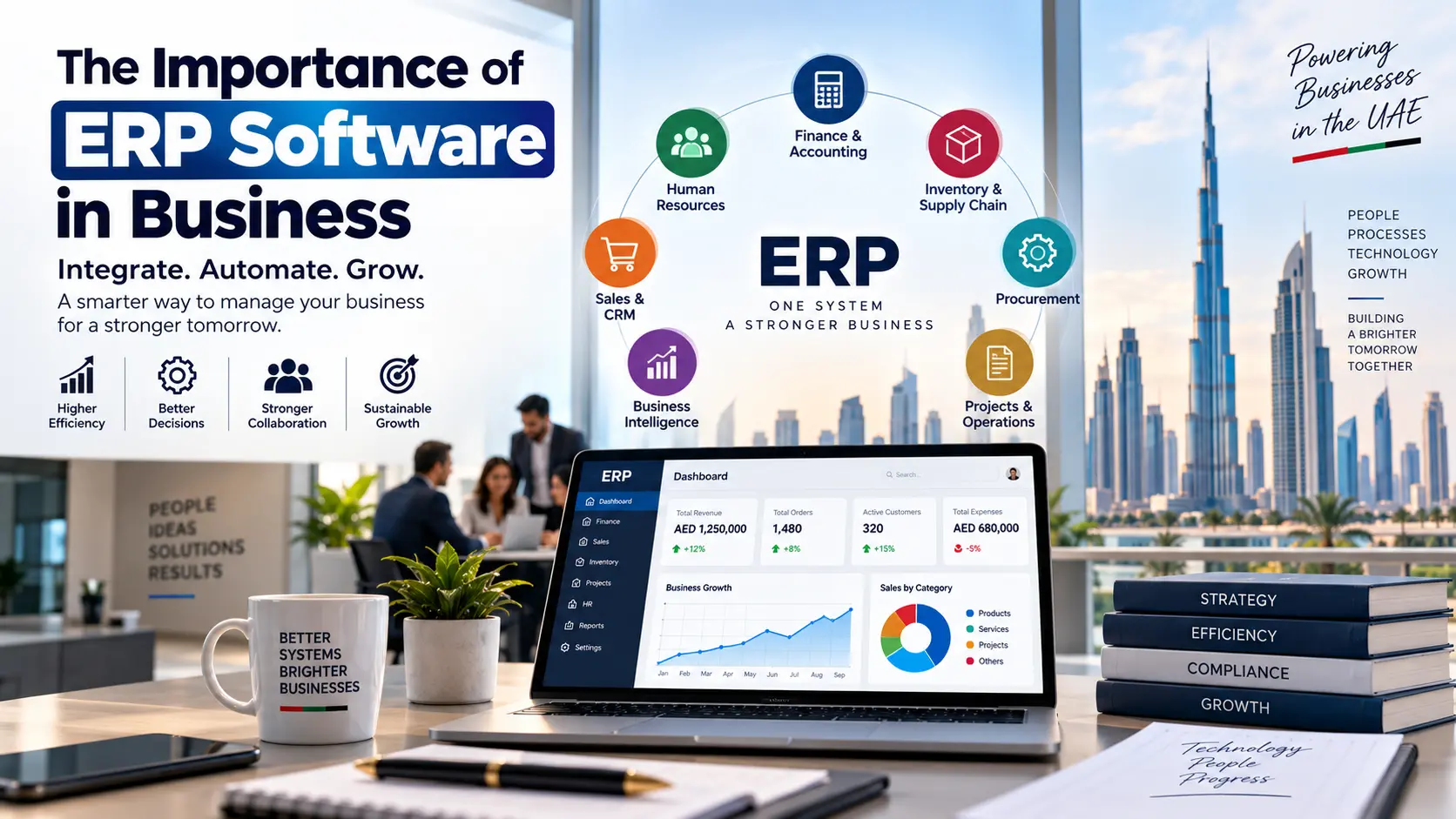
An ERP system brings important business processes together in one connected environment. Depending on the solution and modules selected, an ERP can help manage accounting, finance, purchasing, inventory, sales, human resources, customer information and reporting.
For UAE businesses, ERP software can also support better financial record management and tax-related processes. The Federal Tax Authority requires businesses subject to Corporate Tax to maintain records and documents supporting information reported in their tax returns. Relevant records must generally be retained for at least seven years following the end of the relevant Tax Period.
Key Takeaways
- ERP software connects important business functions and reduces dependence on disconnected systems.
- ERP can improve financial visibility, reporting, workflow management and collaboration.
- Businesses can choose between on-premise, cloud and hybrid ERP systems depending on their requirements.
- ERP can help reduce duplicate data entry and improve consistency when processes are properly configured.
- A suitable ERP system can support business growth by making it easier to manage increasing transactions, users and operational requirements.
- UAE businesses should consider accounting, VAT, Corporate Tax, reporting and record-keeping requirements when evaluating ERP software.
What Is ERP Software?
ERP stands for Enterprise Resource Planning.
ERP software is a business management system designed to connect different functions of an organisation. Instead of keeping accounting, inventory, purchasing and sales information in completely separate systems, an ERP can bring these processes into a shared platform.
For example, when a sales transaction is recorded, the information may also affect inventory and accounting records depending on how the ERP has been configured.
This creates a more connected workflow and gives management a clearer view of business activity.
ERP systems can be used by small businesses, growing companies and large organisations. The right solution depends on factors such as company size, industry, number of users, transaction volume, budget and operational requirements.
Why Is ERP Software Important for Modern Businesses?
The importance of ERP software comes from its ability to connect information and processes.
Imagine a growing trading company that uses one spreadsheet for inventory, another application for sales and separate accounting software for financial records. Employees may need to transfer information between systems manually.
As transaction volumes increase, this approach becomes harder to manage.
An ERP system can bring these processes together, reducing unnecessary duplication and giving authorised users access to information from a common system.
However, ERP is not automatically a solution to every business problem. The benefits depend heavily on proper implementation, accurate data, user training and choosing modules that actually match the company’s needs.
Types of ERP Systems
Businesses generally consider three common ERP deployment approaches.
1. On-Premise ERP
An on-premise ERP is installed on the organisation’s own infrastructure and managed by its internal IT team or technology partner.
This approach can provide greater control over infrastructure and system configuration. It may be suitable for organisations that have specific technical, security or operational requirements.
However, businesses also need to consider hardware, maintenance, updates, backups, security and internal IT resources.
2. Cloud-Based ERP
A cloud ERP is hosted by the software provider or cloud infrastructure provider and accessed through the internet.
Cloud-based ERP systems have become popular because businesses can often scale users and resources more easily without maintaining all the underlying infrastructure themselves.
They can also support remote access, although the exact features depend on the software provider, subscription plan, security configuration and internet connectivity.
For growing businesses, cloud ERP can be an attractive option when flexibility and lower infrastructure management are important considerations.
3. Hybrid ERP
A hybrid ERP combines elements of on-premise and cloud environments.
For example, a business may keep certain systems or data on its own infrastructure while using cloud services for selected applications.
This approach can provide flexibility, but it can also make implementation and integration more complex.
The best deployment model depends on the company’s operational requirements rather than simply choosing the newest technology.
Benefits of ERP Software for Businesses
1. Better Financial Visibility
One of the most important benefits of ERP software is improved visibility into financial information.
An integrated ERP can bring together information such as:
- Sales
- Purchases
- Expenses
- Receivables
- Payables
- Bank transactions
- Inventory
- Assets
- Financial reports
Having organised financial information can help management understand business performance and make decisions based on current records.
For UAE businesses, this is particularly useful because maintaining reliable financial records is an important part of tax compliance. The FTA states that taxable persons should maintain financial statements and records supporting information provided in Corporate Tax returns.
2. Reduces Duplicate Data Entry
Without an integrated system, employees may enter the same customer, product or transaction information into multiple applications.
This takes time and creates opportunities for errors.
An ERP can reduce unnecessary duplicate entry by allowing information to flow between connected modules.
For example, a sales transaction can be connected with inventory and accounting processes when the ERP is configured appropriately.
3. Improves Business Reporting
Business owners need more than raw transaction data. They need useful reports that help them understand what is happening.
ERP systems can provide reports covering areas such as:
- Revenue
- Expenses
- Profitability
- Inventory
- Outstanding receivables
- Payables
- Sales performance
- Cash flow
- Department performance
The exact reporting capabilities vary between ERP products, so businesses should check whether the system can produce the reports they actually need.
4. Helps Improve Decision-Making
Business decisions become easier when managers have reliable information.
For example, a company considering whether to increase inventory can review sales trends, current stock levels and purchasing information before making a decision.
Similarly, management can review receivables and cash-flow information before approving major expenses.
ERP software does not make decisions for the business. Instead, it can give decision-makers better access to organised information.
5. Supports Business Growth
A system that works for a small business may become difficult to manage as the company grows.
More customers, employees, products, branches and transactions usually mean more financial and operational data.
A scalable ERP can allow businesses to add users, modules or functionality as their requirements change.
This can be particularly valuable for growing UAE businesses that are expanding their operations or adding new locations.
6. Improves Collaboration Between Departments
Different departments often depend on the same information.
For example, the sales team may need customer information, the purchasing team may need inventory information, and the finance team may need sales and expense information.
When these teams work with connected systems, information can be easier to share.
This can reduce delays caused by repeatedly requesting spreadsheets or manually transferring information between departments.
7. Better Inventory Management
For trading, retail, distribution and manufacturing businesses, inventory management can have a direct impact on profitability.
ERP software can help businesses track products, purchases, sales and stock movements.
Depending on the ERP, businesses may also be able to monitor reorder levels, warehouses, product costs and inventory reports.
Better inventory visibility can help reduce situations such as overstocking or unexpected stock shortages.
8. Supports Standardised Business Processes
Every employee should not have to follow a completely different process for recording transactions or approving expenses.
ERP implementation can help businesses establish standard workflows.
For example, a company can define how a purchase request moves from approval to purchase order, receipt and accounting entry.
Standardisation can improve consistency and make it easier to identify where a process is slowing down.
9. Supports Data Security and Access Control
ERP systems can provide user roles and access permissions so employees only have access to the information they need.
For example, an employee may be allowed to create sales invoices but not modify certain financial settings.
However, businesses should not assume that every ERP automatically provides complete security. Security depends on the software, configuration, user permissions, authentication, backups, hosting and the organisation’s own security practices.
The FTA’s guidance for tax accounting software also highlights the importance of internal controls, audit trails, data integrity and archival/restoration capabilities.
10. Makes Audit and Record Management Easier
Maintaining organised records becomes increasingly important as businesses grow.
The FTA notes that records supporting Corporate Tax information may include transaction records, asset records, liability records, stock information, bank statements, invoices, purchase and sales ledgers and other relevant documentation.
An ERP can help businesses organise this information within a structured financial system.
It does not replace the company’s responsibility to maintain proper records, but a well-configured system can make information easier to retrieve when required.
11. Supports Remote and Mobile Work
Many modern ERP systems provide browser-based or mobile access.
This can allow authorised users to review information while working outside the office.
For example, a business owner may want to check an outstanding customer balance while travelling, or a manager may need to approve a purchase remotely.
The availability and functionality of mobile access depend on the ERP provider and selected plan.
How ERP Software Can Support UAE Businesses
ERP software can be particularly useful for UAE businesses that are dealing with growing accounting and compliance requirements.
A properly configured ERP can help businesses maintain structured information for:
- Accounting and bookkeeping
- VAT-related transactions
- Corporate Tax reporting
- Customer and supplier records
- Inventory
- Expenses
- Financial statements
- Management reporting
- Audit documentation
The FTA currently maintains a list of accredited tax accounting software vendors, which businesses can consult when evaluating software options.
Businesses should still evaluate software based on their own requirements rather than selecting a product solely because it appears on a list.
How to Choose the Right ERP Software
Choosing ERP software should be treated as a business decision, not simply an IT purchase.
Before selecting a system, consider:
Understand Your Current Problems
Identify what is currently causing delays.
Is it manual bookkeeping? Inventory errors? Slow reporting? Duplicate data entry? Poor communication between departments?
Check Required Features
Make a list of essential modules such as:
- Accounting
- Inventory
- Sales
- Purchasing
- Payroll
- CRM
- Reporting
- Asset management
Consider UAE Tax Requirements
If your business operates in the UAE, check whether the ERP supports the accounting and tax workflows you require.
This is particularly important for businesses managing VAT and Corporate Tax records.
Check Integration Options
Your ERP may need to connect with banking systems, payment platforms, e-commerce websites, payroll software or other business applications.
Plan Employee Training
Even the best ERP will not deliver its full value if employees do not know how to use it correctly.
Training should be part of the implementation plan.
Consider Future Growth
Choose a solution that can reasonably support your expected growth instead of selecting software based only on today’s requirements.
Common Mistakes Businesses Make When Implementing ERP
ERP implementation can fail when businesses focus only on software features.
Common mistakes include:
- Choosing software without clearly defining business requirements
- Migrating inaccurate or duplicate data
- Underestimating employee training
- Trying to customise every part of the system
- Not testing workflows before going live
- Ignoring backup and security procedures
- Failing to define user access permissions
- Not planning for future business growth
A successful ERP implementation usually requires cooperation between management, finance, employees and the technology provider.
Conclusion
ERP software has become an important business management tool for organisations that want better control over their financial and operational information.
The biggest benefit is not simply having another software system. The real value comes from connecting business processes, reducing unnecessary manual work and giving decision-makers reliable information.
For UAE businesses, ERP can also support better accounting practices and organised financial records, which are increasingly important as businesses manage VAT, Corporate Tax and other compliance responsibilities.
The right ERP system should fit the business rather than forcing the business into an unsuitable workflow. Before choosing a solution, businesses should assess their current processes, reporting needs, tax requirements, integrations, budget and future growth plans.
With proper planning, implementation and training, ERP software can become a practical foundation for more organised accounting, efficient operations and sustainable business growth.
Frequently Asked Questions
1.What is ERP software in simple terms?
ERP software is a business management system that connects different functions such as accounting, sales, purchasing, inventory and reporting in one integrated environment.
2.Why is ERP software important for small businesses?
ERP software can help small businesses reduce manual work, organise financial information, improve reporting and create more structured processes as the company grows.
3.Is cloud ERP better than on-premise ERP?
Not necessarily. Cloud ERP can offer flexibility and reduce infrastructure management, while on-premise ERP may provide greater control for businesses with specific requirements. The right option depends on the company’s needs.
4.Can ERP software help with accounting?
Yes. Many ERP systems include accounting and finance modules for areas such as sales, purchases, expenses, receivables, payables, reporting and financial records.
5.Can ERP software help UAE businesses with tax compliance?
ERP software can help organise financial and transaction data used for tax reporting and record-keeping. However, software alone does not guarantee tax compliance. Businesses should configure the system correctly and follow applicable UAE tax requirements.
6.How long should UAE Corporate Tax records be kept?
The FTA states that relevant records and documents should generally be retained for at least seven years following the end of the relevant Tax Period.