

Introduction
For many small businesses in the UAE, e-Invoicing can feel like another complicated compliance requirement.
But the basic idea is actually quite simple.
The UAE is moving towards a system where businesses exchange structured electronic invoices through an approved digital framework instead of relying only on traditional paper invoices, PDFs or email attachments.
The UAE Ministry of Finance explains that a PDF, Word document, image, scanned invoice or ordinary email attachment is not an eInvoice by itself. An eInvoice contains structured invoice data that is electronically exchanged and reported through the UAE e-Invoicing system.
For a small business, the biggest challenge may not be creating the invoice. It is getting your accounting data, software and internal process ready.
The good news is that you don’t have to change everything overnight.
With the right preparation, your business can move towards UAE e-Invoicing in a much more organized way.
What Is UAE e-Invoicing?
UAE e-Invoicing is a digital system for issuing, exchanging and reporting structured invoice information.
Instead of creating an invoice, saving it as a PDF and sending it manually, the required invoice data is exchanged electronically through the UAE’s approved e-Invoicing framework.
The system uses the OpenPeppol standard, which helps different accounting and business systems exchange structured documents in a consistent way.
For small businesses, this can eventually reduce some manual work around:
- Invoice processing
- Data entry
- Reconciliation
- Record keeping
- Invoice exchange
- Tax reporting
But those benefits depend heavily on having accurate accounting data.
Does e-Invoicing Apply to Small Businesses?
Yes, small businesses can fall within the UAE e-Invoicing system.
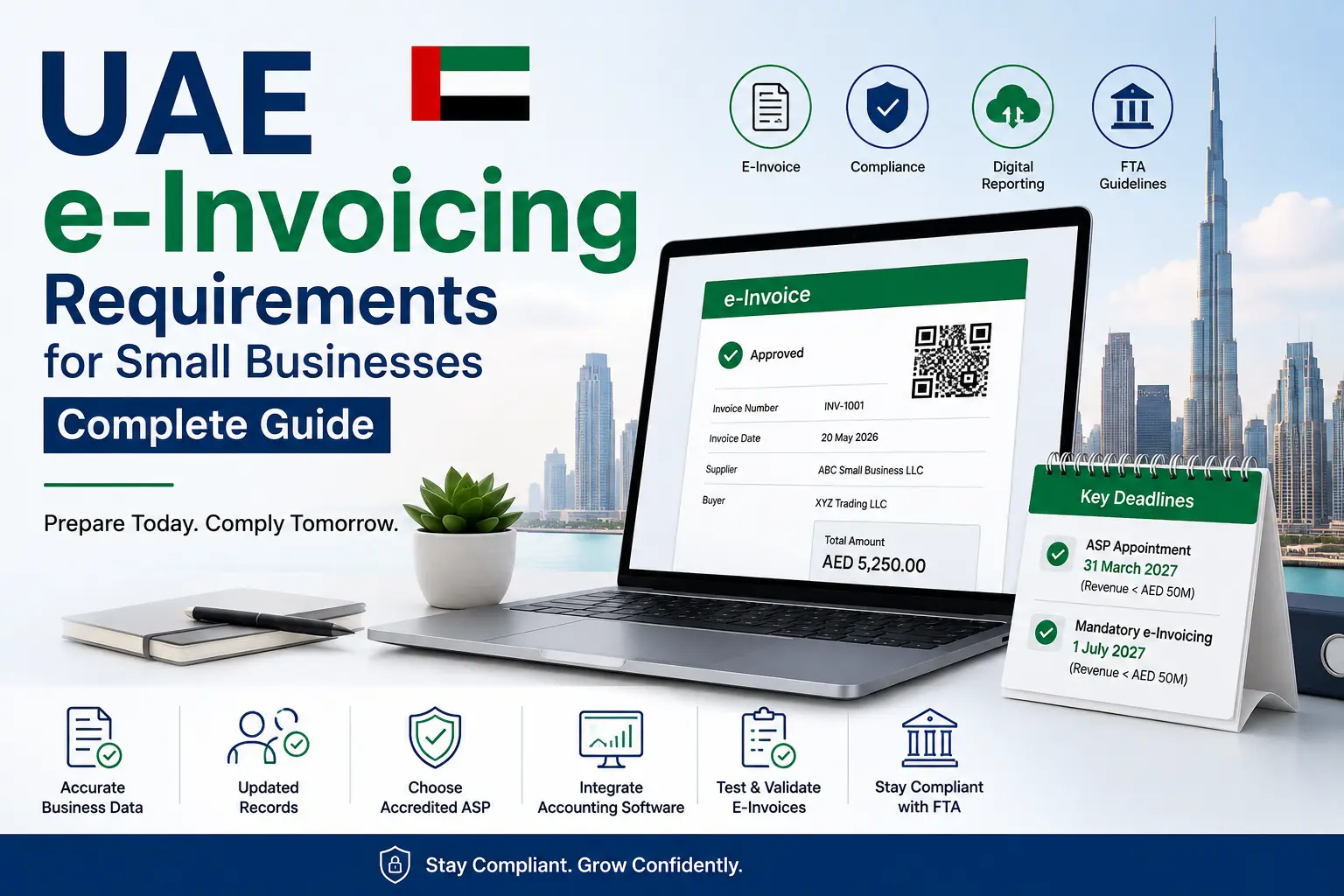
The mandatory implementation is being introduced in phases based on annual revenue.
| Business category | ASP deadline | Mandatory implementation |
|---|---|---|
| Annual revenue AED 50 million or more | 30 October 2026 | 1 January 2027 |
| Annual revenue below AED 50 million | 31 March 2027 | 1 July 2027 |
| In-scope Government Entities | 31 March 2027 | 1 October 2027 |
The Ministry of Finance extended the ASP appointment deadline for businesses with revenue above AED 50 million from 31 July 2026 to 30 October 2026. The mandatory implementation date for that group remains 1 January 2027.
For smaller businesses with revenue below AED 50 million, the current mandatory implementation date is 1 July 2027.
Can a small business start earlier?
Yes.
The UAE framework allows businesses to voluntarily implement e-Invoicing from 1 July 2026, provided they follow the applicable technical requirements.
This can be useful for businesses that want more time to test their systems and train their employees.
What Should a Small Business Prepare?
You don’t need to completely rebuild your accounting operation.
Instead, focus on a few important areas.
1. Check Your Business Information
Start with your basic company information.
Make sure the details used by your accounting system match your official records.
Check:
- Legal business name
- TRN
- TIN, where applicable
- Registered address
- VAT information
- Business email
- Customer information
- Supplier information
A simple mismatch may not seem important today, but incorrect master data can create problems when information needs to move between systems.
2. Review Your Customer and Supplier Records
This is one of the most practical things a small business can do before e-Invoicing becomes mandatory.
Look through your customer and supplier list.
Check whether important information is:
- Complete
- Accurate
- Up to date
- Consistent
For business customers, pay particular attention to relevant tax registration information.
Example
Imagine a small Abu Dhabi trading company has 400 customer records.
The company discovers that:
- 35 customers have incomplete addresses.
- 12 records have outdated company names.
- Several VAT-related details are missing.
- Some old suppliers are still active in the accounting system.
If the business waits until the final month to fix everything, the accounting team could spend days cleaning the database.
Doing it gradually is much easier.
3. Review Your Accounting Software
Your accounting software needs to support the UAE e-Invoicing requirements.
If you’re using TallyPrime, review your current version and configuration before implementation.
TallyPrime’s UAE e-Invoicing functionality includes preparation areas such as company information, party masters, stock items, VAT settings, UOM/UQC mapping and e-Invoice reporting.
Don’t assume that simply updating the software completes the whole process.
Your data and configuration also need to be ready.
4. Check Your VAT Information
Small businesses should review how VAT information is recorded in their accounting system.
Check:
- VAT registration number
- Tax rates
- Sales ledgers
- Purchase ledgers
- Product tax treatment
- Service tax treatment
- Credit notes
- Customer tax information
This is particularly important if your business handles different VAT treatments.
The goal isn’t just to create an electronic invoice.
The invoice data needs to be accurate and complete.
5. Review Products and Services
If your business sells products, review your stock records.
If you provide services, review your service descriptions.
Make sure your records are understandable and consistent.
For product-based businesses, also check:
- Product names
- Descriptions
- Units
- Quantities
- Prices
- VAT treatment
- UOM
- UQC mapping where applicable
This may sound like basic accounting work, but clean master data makes digital invoicing much easier.
6. Understand UOM and UQC
Businesses often use internal terms such as:
- Piece
- Box
- Carton
- Kilogram
- Bundle
- Bottle
However, e-Invoicing systems may require standardized unit information.
For this reason, businesses using accounting software such as TallyPrime should review their Unit of Measurement (UOM) and applicable Unit Quantity Code (UQC) mapping.
This is an area where small data errors can easily be overlooked.
7. Choose an Accredited Service Provider
An Accredited Service Provider (ASP) plays an important role in the UAE e-Invoicing framework.
The Ministry of Finance publishes the official list of accredited providers and updates it periodically.
When choosing an ASP, don’t look only at the cheapest option.
Consider:
- Accounting software compatibility
- Integration options
- Technical support
- Data security
- Pricing
- Implementation support
- Customer service
- Scalability
For a small business
You probably don’t need the most complicated solution available.
You need a provider that fits your business size, accounting system and expected invoice volume.
8. Understand the EmaraTax Process
Businesses can access the FTA’s EmaraTax system to select their preferred Accredited Service Provider and start their e-Invoicing journey. The Ministry of Finance explains that businesses then enter into a commercial agreement with their chosen ASP before completing onboarding.
If you’re already using TallyPrime, you should coordinate the EmaraTax onboarding with your accounting software preparation.
This avoids treating registration and accounting setup as two completely separate projects.
9. Prepare Your Team
Technology is only one part of e-Invoicing.
Your employees also need to understand what is changing.
Your accounting team should know:
- How invoices will be created
- How credit notes will be handled
- How customer information should be entered
- Who checks rejected invoices
- Who communicates with the ASP
- How errors are corrected
- How records are maintained
Even a good system can create problems if users enter incomplete information.
10. Test Before Going Live
This is one of the steps I would not skip.
Before relying on the new process for everyday transactions, test it.
Try common scenarios such as:
- Normal B2B invoice
- Different VAT treatment
- Credit note
- Multiple products
- Different customers
- Invoice correction
- Failed or rejected transaction
The UAE Ministry of Finance encourages businesses to plan ahead, make the necessary system changes and test the e-Invoicing process before implementation.
Simple Example: A Small UAE Business
Let’s say Bright Star Trading LLC, a small Abu Dhabi business, currently creates invoices in TallyPrime and sends PDF copies to customers.
The owner decides to prepare for UAE e-Invoicing early.
Month 1
The business checks:
- TallyPrime version
- TRN
- Company details
- Customer records
Month 2
The accountant reviews:
- VAT rates
- Products
- UOM
- UQC
- Supplier records
Month 3
The company selects an ASP and begins onboarding.
Month 4
The team tests invoices and trains employees.
By the time mandatory implementation arrives, the business isn’t trying to solve everything at once.
That’s the advantage of early preparation.
Common Mistakes Small Businesses Should Avoid
Waiting for the deadline
Starting early gives you more time to fix problems.
Treating PDF invoices as eInvoices
A PDF alone doesn’t meet the UAE definition of an eInvoice.
Ignoring old customer data
Incomplete records can create unnecessary problems during implementation.
Choosing an ASP only because of price
Software compatibility and support are equally important.
Not testing
Never make your first real customer transaction your first test.
Forgetting employee training
Your accounting system is only as good as the information users enter.
UAE e-Invoicing Preparation Checklist
Before your business goes live, review this checklist:
- ✓ Company information
- ✓ TRN
- ✓ VAT information
- ✓ Customer records
- ✓ Supplier records
- ✓ Customer tax details
- ✓ Product/service information
- ✓ VAT rates
- ✓ UOM
- ✓ UQC
- ✓ Accounting software
- ✓ ASP selection
- ✓ EmaraTax onboarding
- ✓ Employee training
- ✓ Testing
- ✓ Error-handling process
Frequently Asked Questions
1.Is e-Invoicing mandatory for small businesses in the UAE?
Businesses below AED 50 million in annual revenue that fall within the scope of the system have a current mandatory implementation date of 1 July 2027, with an ASP appointment deadline of 31 March 2027.
2.Can a small business start e-Invoicing before its deadline?
Yes. Voluntary implementation is available from 1 July 2026, subject to the applicable technical requirements.
3.Is a PDF invoice considered an eInvoice?
No. A PDF, Word document, image, scanned invoice or email attachment by itself is not considered an eInvoice under the UAE framework.
4.Does a small business need an ASP?
Businesses that are subject to the mandatory e-Invoicing system need to appoint an Accredited Service Provider within the applicable timeline.
5.Should small businesses change their accounting software?
Not necessarily. The key requirement is to use a solution that can support the UAE e-Invoicing framework. Businesses using TallyPrime should review their current version and configuration.
Conclusion
For small businesses, UAE e-Invoicing preparation doesn’t need to be stressful.
The best approach is to start with the basics: clean your accounting records, check your customer and supplier information, review VAT settings, prepare your products and services, select an Accredited Service Provider and test your invoicing process.
Don’t wait until the mandatory deadline to discover that your accounting data needs attention.
A few hours spent preparing your records today can save your team much more time later.