

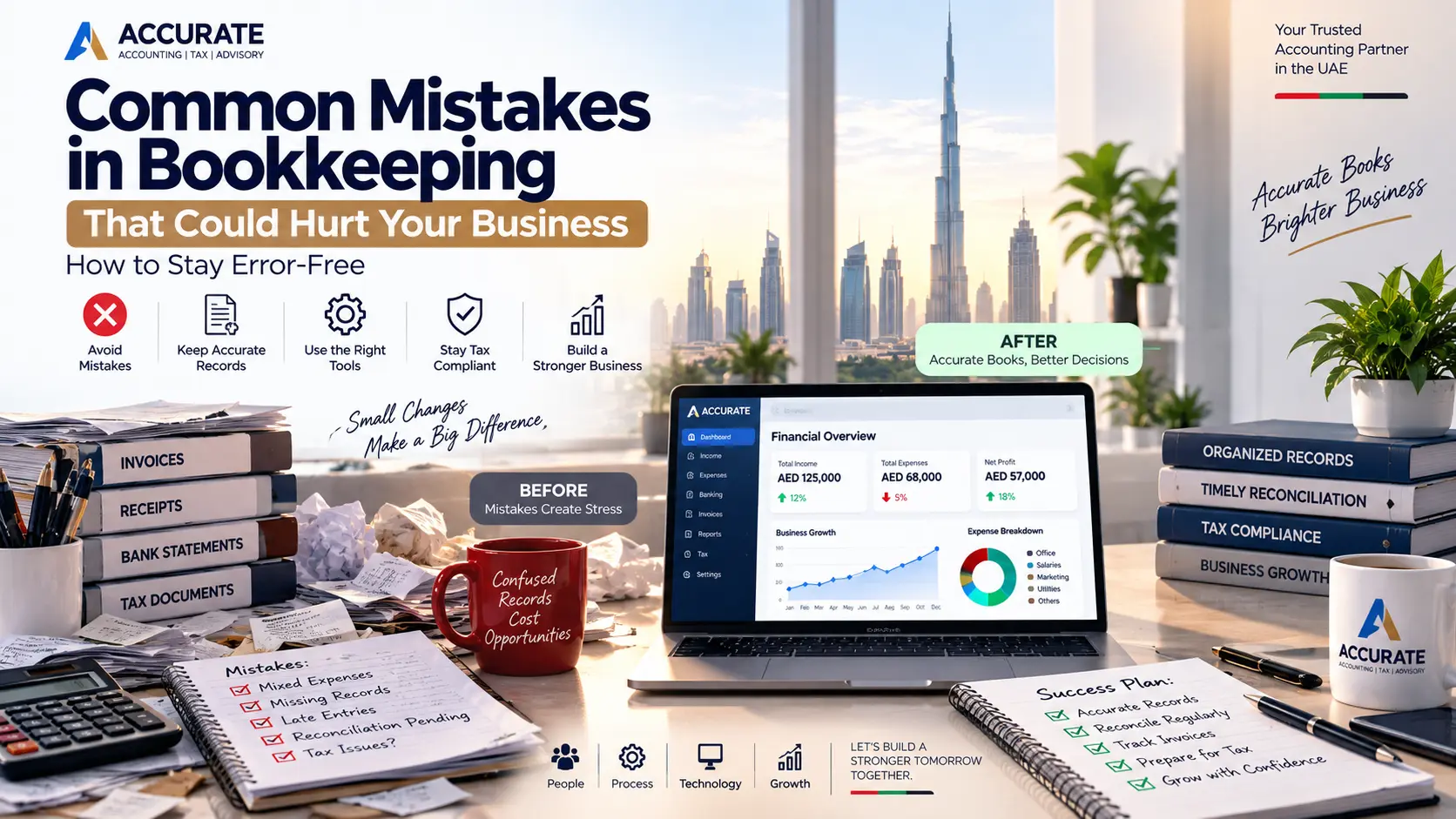
Bookkeeping may seem like a routine part of running a business, but small errors in financial records can create much bigger problems later. A missed expense, incorrect transaction, duplicate entry or unreconciled bank account can affect your financial reports and make it harder to understand the actual health of your business.
For small and growing businesses, accurate bookkeeping is especially important. Your financial records help you monitor cash flow, understand expenses, prepare reports and stay ready for tax requirements.
In the UAE, good record keeping also supports VAT and Corporate Tax compliance. The Federal Tax Authority expects businesses to maintain records that support their tax position, while Corporate Tax records generally need to be retained for at least seven years after the relevant Tax Period.
The good news is that most bookkeeping mistakes can be prevented with a simple, consistent process.
Let’s look at the most common bookkeeping mistakes businesses make and practical ways to avoid them.
Why Accurate Bookkeeping Matters
Good bookkeeping gives you a clearer picture of how your business is performing.
It helps you understand:
- How much money your business is receiving
- Where your money is being spent
- Which customers still owe you money
- Which suppliers need to be paid
- Whether expenses are increasing
- Whether the business is generating a profit
- What financial information is needed for tax reporting
Without reliable records, business owners may make decisions based on incomplete or incorrect information.
10 Common Bookkeeping Mistakes Businesses Should Avoid
1. Mixing Business and Personal Expenses
One of the most common bookkeeping mistakes is using business funds for personal expenses or personal accounts for business purchases.
This makes it difficult to identify genuine business expenses and can make financial reporting unnecessarily complicated.
How to avoid it
Keep business and personal finances separate.
Use:
- A dedicated business bank account
- A business credit or debit card
- Separate expense records
- Clear descriptions for business transactions
Example:
If a business owner buys office equipment using a personal card, the transaction should still be properly recorded and supported by the relevant documentation rather than simply being forgotten.
2. Recording Transactions Too Late
Waiting several weeks or months before updating your books can create unnecessary problems.
You may forget the reason for a payment, lose receipts or overlook an unpaid customer invoice.
A better approach is to maintain bookkeeping regularly rather than treating it as a once-a-year task.
Simple approach
Set a weekly or monthly bookkeeping routine depending on your transaction volume.
Regular updates make it easier to identify mistakes while the information is still fresh.
3. Not Reconciling Bank Accounts
Your accounting records should be compared with your actual bank transactions regularly.
This process can help identify:
- Missing transactions
- Duplicate entries
- Bank charges
- Incorrect amounts
- Unrecorded payments
- Outstanding transactions
If your accounting software shows AED 85,000 in the bank but your actual bank statement shows AED 81,500, the difference needs to be investigated.
Ignoring the difference can eventually lead to inaccurate financial reports.
4. Misclassifying Expenses
Not every business expense belongs in the same category.
For example, office rent, employee salaries, advertising, software subscriptions and equipment purchases should be recorded appropriately.
Incorrect classification can make your financial reports misleading.
Best practice
Create clear expense categories and use them consistently.
If you are unsure how a particular transaction should be recorded, getting professional accounting advice is better than guessing.
5. Failing to Track Accounts Receivable
Sales are not the same as cash received.
A customer may receive an invoice today but pay it 30 or 60 days later.
If outstanding invoices are not monitored, your business may appear profitable while still experiencing cash-flow pressure.
Keep track of:
- Invoice date
- Customer name
- Invoice amount
- Due date
- Payment status
- Overdue days
A regular receivables review can help you follow up with customers before unpaid invoices become a serious cash-flow problem.
6. Ignoring Accounts Payable
The opposite problem can happen with supplier payments.
If supplier invoices are not recorded properly, a business may:
- Miss payment deadlines
- Pay the same invoice twice
- Lose track of outstanding bills
- Damage supplier relationships
Maintain a simple payable schedule showing what is due and when.
7. Not Keeping Supporting Documents
A bookkeeping entry should have proper supporting information where applicable.
Depending on the transaction, this could include:
- Sales invoices
- Purchase invoices
- Receipts
- Bank statements
- Credit notes
- Expense documents
- Payroll records
- Asset records
The FTA specifically highlights the importance of maintaining records supporting information reported in tax filings.
For VAT-registered businesses, tax invoices and related VAT records also need to be retained according to the applicable requirements.
8. Relying Too Much on Manual Spreadsheets
Spreadsheets can be useful for simple tasks, but they can become difficult to manage as the number of transactions increases.
Common problems include:
- Incorrect formulas
- Accidental deletion
- Duplicate entries
- Multiple versions of the same file
- Manual data-entry errors
Accounting software can automate many routine tasks and give businesses a more organized way to manage their financial information.
For a deeper look at this topic, see our guide on <a href=”https://accurate.ae/revolutionizing-accounting-the-use-of-technology-in-accounting/”>how technology is revolutionizing accounting</a>.
9. Failing to Back Up Financial Data
Financial records should not depend on one computer or one spreadsheet.
Hardware failure, accidental deletion or security incidents can result in data loss.
Better practice
Use secure cloud-based systems or reliable backup procedures and make sure access is limited to authorized users.
Regular backups provide an additional layer of protection for important financial information.
10. Leaving Tax Preparation Until the Last Minute
One of the biggest mistakes businesses can make is waiting until a tax deadline is approaching before reviewing their accounts.
Tax preparation becomes much easier when bookkeeping is already up to date.
For UAE businesses, accurate accounting records can support VAT compliance and Corporate Tax reporting. The FTA states that Corporate Tax returns and any Corporate Tax due are generally required within nine months from the end of the relevant Tax Period.
This is why tax preparation should be treated as an ongoing process rather than a once-a-year activity.
How Bookkeeping Errors Can Affect Your Business
| Bookkeeping Problem | Possible Business Impact | Better Approach |
|---|---|---|
| Mixing personal and business expenses | Confusing records | Separate accounts |
| Late transaction entry | Missing information | Update regularly |
| No bank reconciliation | Incorrect balances | Reconcile regularly |
| Wrong expense category | Misleading reports | Use clear categories |
| Untracked invoices | Cash-flow problems | Review receivables |
| Missed supplier bills | Late payments | Maintain payable records |
| Missing documents | Difficult verification | Store supporting records |
| Manual data entry | Higher error risk | Use accounting software |
| No backup | Risk of data loss | Maintain secure backups |
| Last-minute tax preparation | Stress and compliance risk | Review throughout the year |
How to Keep Your Bookkeeping Error-Free
You don’t need a complicated system to improve your bookkeeping.
Start with these simple habits:
1. Keep records updated regularly
Don’t allow transactions to pile up for months.
2. Reconcile your bank accounts
Compare your accounting records with actual bank activity.
3. Store documents properly
Keep invoices, receipts and other supporting documents organized.
4. Review financial reports
Check your profit and loss statement, balance sheet and cash-flow information regularly.
5. Use suitable accounting software
Automation can reduce repetitive manual work and improve consistency.
6. Separate business and personal finances
This makes your records much easier to manage.
7. Get professional support when necessary
As your business grows, professional bookkeeping support can save time and help identify issues before they become expensive problems.
Example: A Small Business Bookkeeping Problem
Imagine a small consulting company in Abu Dhabi with 20–30 customer invoices every month.
The owner manages everything through spreadsheets and checks the accounts only at the end of each quarter.
After three months, the business discovers that:
- Two customer payments were not recorded.
- One supplier invoice was entered twice.
- Several receipts are missing.
- An overdue customer invoice was never followed up.
- Bank charges were not recorded.
None of these errors looked serious individually.
Together, however, they created an inaccurate view of the company’s cash position.
If the company had reconciled its bank account monthly and reviewed receivables and expenses regularly, most of these issues could have been identified much earlier.
How Technology Can Reduce Bookkeeping Errors
Modern accounting technology can make bookkeeping more organized and less dependent on manual data entry.
Depending on the system, businesses can benefit from:
- Automated transaction recording
- Digital invoices
- Bank reconciliation tools
- Expense tracking
- Financial reports
- Document storage
- User access controls
- Cloud-based access
Businesses looking to modernize their financial processes can also explore
The right system should match the size, transaction volume and requirements of the business rather than simply offering the largest number of features.
Bookkeeping and UAE Tax Compliance
Accurate bookkeeping becomes particularly important when your business has tax obligations.
Your accounting records should support the figures reported in relevant tax filings.
For Corporate Tax, the FTA expects taxpayers to maintain financial statements and documents supporting information included in their Corporate Tax return.
The FTA also states that relevant Corporate Tax records should generally be retained for at least seven years after the end of the relevant Tax Period.
For businesses, this means bookkeeping should not be viewed simply as data entry. It is part of maintaining a reliable financial record of the business.
You can also read our detailed guide on the
When Should You Consider Professional Bookkeeping Support?
Professional support can be useful when:
- Your transaction volume is increasing
- You have multiple bank accounts
- You employ staff
- You have regular VAT transactions
- Customers frequently pay on credit
- You are preparing for Corporate Tax filing
- Your financial reports don’t seem accurate
- You spend too much time managing accounts
The goal is not simply to outsource bookkeeping. The goal is to have reliable financial information that helps you run the business with confidence.
FAQs
1.What is the most common bookkeeping mistake?
Mixing business and personal expenses is one of the most common mistakes. Other frequent problems include late data entry, poor bank reconciliation, incorrect expense classification and missing supporting documents.
2.How often should a business reconcile its bank account?
For many businesses, monthly reconciliation is a practical minimum. Businesses with high transaction volumes may benefit from more frequent reviews.
3.Can bookkeeping mistakes affect tax compliance?
Yes. Incorrect or incomplete financial records can make it difficult to prepare accurate tax filings and support the information reported to tax authorities.
3.Is accounting software necessary for a small business?
Not every small business needs the same software. However, as transactions increase, suitable accounting software can reduce manual work and improve financial record management.
4.How long should UAE Corporate Tax records be kept?
The FTA states that Corporate Tax records and documents should generally be kept for at least seven years following the end of the relevant Tax Period.
Conclusion
Bookkeeping errors rarely happen because a business owner wants to keep inaccurate records. They usually happen because financial tasks are handled manually, updated too late or not reviewed regularly.
The best solution is to build a simple and consistent bookkeeping process.
Keep business and personal expenses separate, record transactions regularly, reconcile bank accounts, track receivables and payables, keep supporting documents safe and use suitable accounting technology as your business grows.
For UAE businesses, maintaining accurate records also provides a stronger foundation for VAT and Corporate Tax compliance.
If bookkeeping is taking too much of your time or you are unsure whether your financial records are accurate, professional bookkeeping support can help you maintain organized accounts and make better financial decisions.